If you can open a Bible in your own language and read it for yourself, you are living out the vision Wycliffe worked for. He believed that anyone should be able to read God’s Word for themselves. More than a century before Luther posted his Ninety-Five Theses on the church door at Wittenberg, Wycliffe was already insisting that the Bible—not popes, priests or church tradition—is the final authority for faith and life.
Can you imagine going to church, hearing the Bible read in a language you do not understand, and having to depend on others to explain God’s Word to you? This was England nearly 700 years ago, in the world in which John Wycliffe (ca. 1328–1384) grew up. Church services and much of the Church’s formal teaching were in Latin, although sermons for ordinary people could be given in English. You could not simply open a Bible in English and read it for yourself—because no complete English Bible yet existed. Wycliffe would help change that forever.
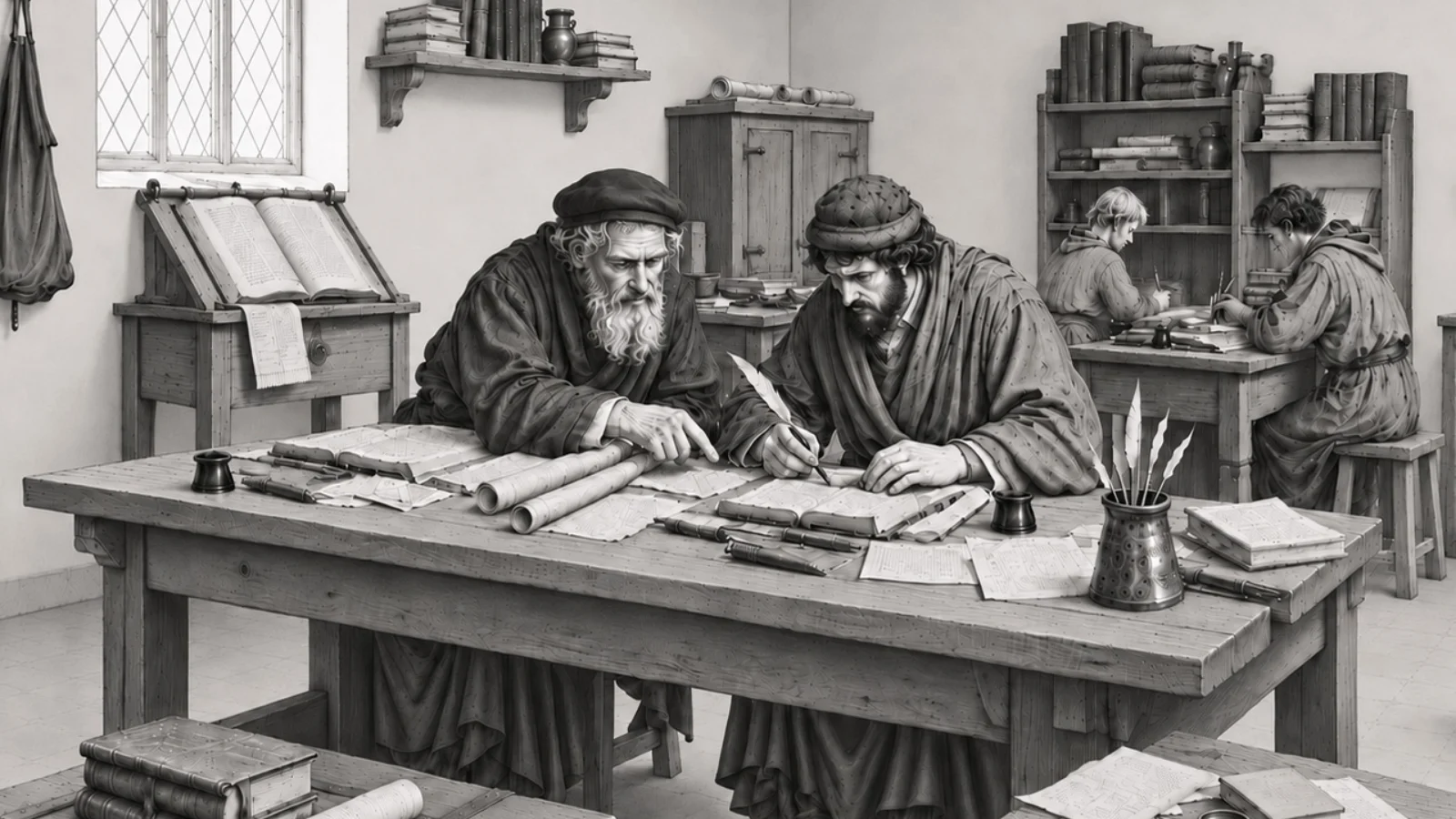
Wycliffe was first and foremost a scholar and began his academic career at Oxford, where he became known as a philosopher and theologian. The more he studied the Bible and theology, the more he began to question some of the Church’s teachings and practices. Wycliffe came to see the Bible not merely as a religious text for church leaders, but as God’s authoritative Word and the highest standard of truth.
He reasoned that if the Bible was God’s authoritative Word, everyone should be able to read and understand it—not just priests and the educated. By the early 1380s, when Wycliffe was in his fifties, scholars at Oxford began translating the Latin Vulgate (the Church’s official Latin Bible) into English. Whether Wycliffe translated a single verse himself, we cannot say. More than a century later, William Tyndale would begin translating directly from the original Greek and Hebrew.
His commitment to the Bible also gave him the courage to challenge teachings that contradicted Scripture. One such teaching was the doctrine of transubstantiation, which taught that during the Mass the bread and wine truly became the body and blood of Christ, even though they still looked and tasted the same. Wycliffe questioned whether such a teaching could be supported by the Bible. His insistence on testing Church teachings and practices against the Bible cost him much of his support and protection. Still, he continued to speak openly about what he believed the Bible taught.
Wycliffe died in 1384, but his call to return to the Bible lived on. He was eventually condemned as a heretic at the Council of Constance in 1415, with his remains dug up and burned in 1428, over 40 years after his death. Yet none of this could undo the influence of a man whose life was shaped by the conviction that the Word of God must govern the people of God.
What We Can Learn from John Wycliffe
1. Let the Bible Be the Highest Authority in Your Life
(Isa. 8:20; Mark 7:8–13; Acts 17:11; 2 Tim. 3:16–17; 2 Pet. 1:19–21) Wycliffe’s study of Scripture was more than an academic exercise. The more seriously he took God’s Word, the more willing he was to test his own beliefs, Church teachings, and the culture around him against Scripture. His life reminds us that the Bible is not simply something we read for knowledge; it is God’s Word, and it should shape what we believe and how we live.
2. Know the Bible for Yourself
(Ps. 119:105; Josh. 1:8; Ps. 1:1–2; John 5:39; Acts 17:11; Col. 3:16) Wycliffe believed we should not depend only on pastors or teachers to tell us what the Bible says. Pastors and teachers can guide and help us, but we should also read and study the Bible for ourselves. In doing so, we grow in faith, know God better, and learn to test what we hear against Scripture. Today, we have easy access to the Bible, yet we can still easily neglect it. Wycliffe’s life reminds us to treasure God’s Word, read it faithfully, and be thankful for the privilege of having it so freely available.
3. Correct False Teaching with the Truth of Scripture
(Acts 17:11; 1 Thess. 5:21; 2 Tim. 4:2–4; Titus 1:9; Jude 3) Wycliffe was willing to challenge teachings and practices that had moved away from the Bible, even when it cost him influence and support. We too should have the courage to submit ourselves to the truth of the Bible and, with humility, challenge error when we encounter it—even when doing so is unpopular.
4. Share the Bible with Others
(Ps. 96:2–3; Luke 24:27; John 20:30–31; Rom. 10:14–17; 2 Tim. 3:15) Wycliffe’s desire to make the Bible available in English grew from his deep belief in its importance. God reveals Himself through the Bible, and this should move us to encourage others to read it, understand it, and respond to it.
This biography first appeared in Dew Arabia Edition Four: The Word of God, page 63.