

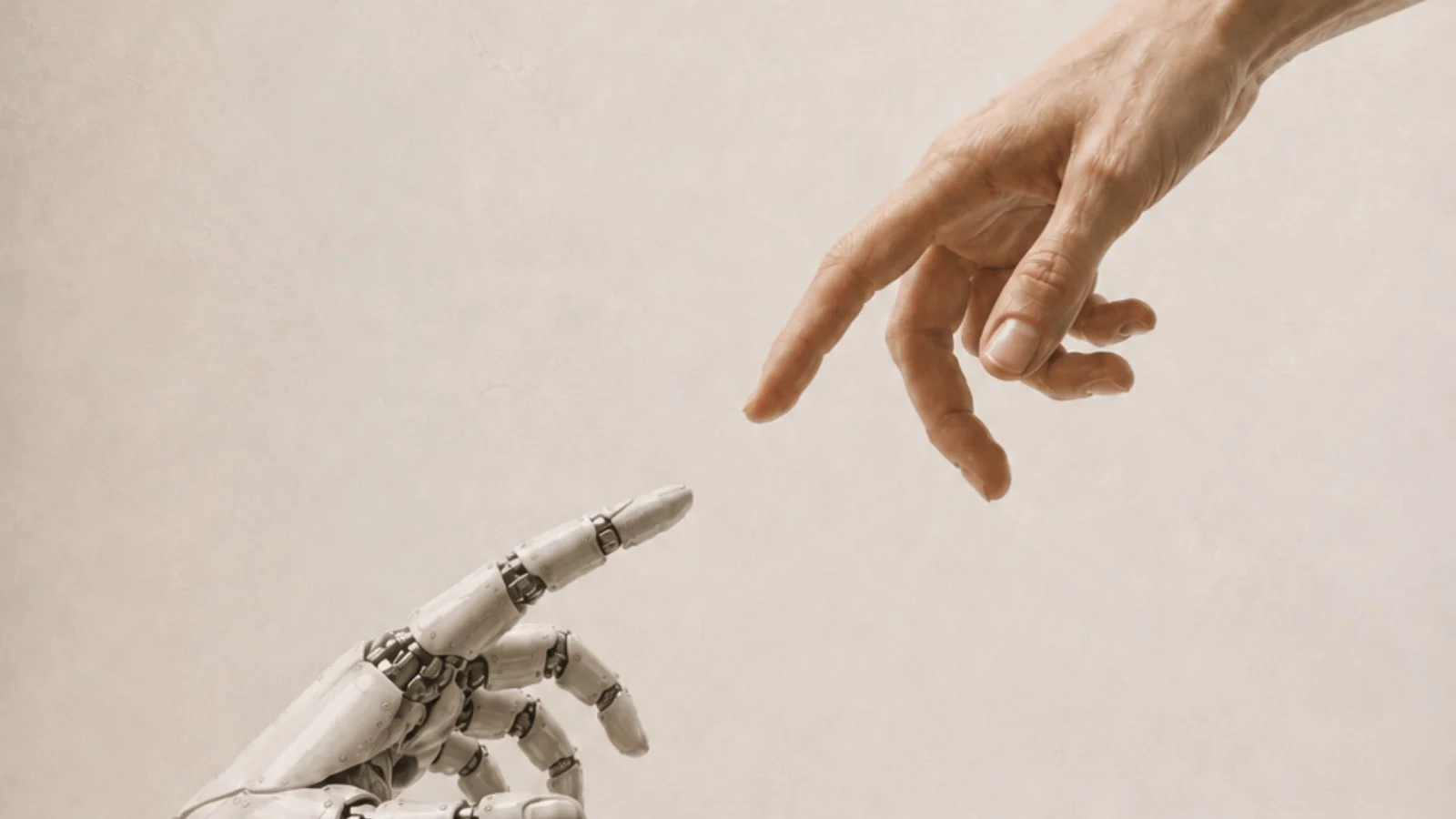
The aliens are finally here; yet no one recognises them. For decades human beings have been obsessed with aliens—powerful extraterrestrial beings who could take over planet Earth. In the United States, for example, conspiracy theories abound regarding the so-called landing of Unidentified Flying Objects (UFOs) in the 1940s carrying extraterrestrial beings. Regardless of one’s belief about UFOs, no one would want extraterrestrial beings with unmitigated power invading Mother Earth and upending our peaceful existence.
To an extent, that is what the emergence of Artificial Intelligence (AI) feels like.
AI as a productivity tool has been around for a while; however, the way and manner in which it has grown over the past few years has been nothing short of an alien-like invasion. It has taken over jobs, displaced industries that have been in existence for centuries—like legal aides, customer service, personal assistants, and other forms of Christian ministry—and it threatens to take over more. Across many companies, insatiable shareholders are pushing for more returns, and business executives see AI as the saviour that would lead them to that promised land of record-breaking profits. Never mind its effects on millions of workers and their families whose livelihoods are taken away by this power-grabbing alien called AI. There is an unprecedented push in almost every industry for employees to adopt the use of AI in everything they do. For some folks, AI adoption feels like receiving the mark of the beast the apostle John speaks about in Revelation 13:16–18. This is because it appears that, without AI, nothing can be done either in the corporate world or in our personal lives. Although AI is in its nascent stage, there are many people who cannot imagine life without AI. It is therefore not surprising that the posture of many Christians towards AI is so negative, and that includes practitioners of Christian education. Some of my recent conversations showed that some Christians view AI as a threat against the creation mandate, where God charged man to be fruitful and multiply (cf. Genesis 1:26–28; 2:15). Their question is: how can that mandate be fulfilled when AI is taking over all the jobs?
For practitioners of higher education, the concern is slightly different. Aside from the unethical behaviour of some students submitting AI-generated content as their own work, there is also a concern about whether AI is dulling the minds of students and what that means for the creation mandate. As a result, the initial response of many educational institutions has been one of outright rejection of AI in all its forms in academic work. For example, my seminary requires students to put a declaration at the bottom of all their writing assignments affirming that no AI was used. However, the question is: is this the best way for Christians to respond to AI—to move to the other side of the pendulum? In this essay, I offer four reflections on AI and how Christians should approach it based on St Augustine of Hippo’s framework on how Christians can benefit from pagan institutions. The position of this article is that Christians should not shun the use of AI wholesale nor embrace it uncritically, but appropriate what is useful in it.
Learning the Alphabet
In Teaching Christianity II.40.101, Augustine of Hippo, one of the most influential thinkers in the history of the Western world, writes:
“Christians must not altogether shun those human institutions that are indispensable to a productive way of life. Up to a point, in fact, we should pay attention to them and be mindful of them… Above all this means letters of the alphabet, without which reading is impossible… institutions like those are useful; there is nothing wrong with learning them.”1
It was believed in Roman mythology that the alphabet originated from the pagan god, Mercury; as a result, some Christians were reluctant to learn it. In my 21st-century mind, I cannot possibly think of any reason why anyone would oppose learning the alphabet. As a matter of human rights, it is a criminal offence punishable under law in most countries for a parent not to send their children to school. Education, which involves learning to read and write, is part and parcel of every civilised society. It is therefore unimaginable to think that there was a time when some Christians opposed learning the alphabet. I wonder how these Christians were expecting to read the Word of God in its written form, if they had not learned how to read by first learning the alphabet.
To what extent AI adoption will become a human right in the future, I cannot tell, but it has certainly changed the way people learn today. For example, sitting in Dubai, in the United Arab Emirates, I am able to join theological conversations that have been going on for centuries without travelling around the world combing through libraries and monasteries. Through Research Rabbit, an AI tool, I am able to identify and read the leading voices on particular doctrinal issues before chiming in. That is a huge blessing! It has been said that “we all stand on the shoulders of those who have gone before us,” and that certainly includes the acquisition of knowledge. Our knowledge of God and His dealings with His creation is built progressively, and therefore the fact that AI helps to synthesise centuries-long conversations in order to add our own voice is something that must be celebrated rather than opposed. This is just one example of how AI can be a blessing. I am sure as time goes on, there will be many other blessings that will become apparent from the use of AI for the Christian.
What About the Harmful Effects of AI?
Having said that, I am also cognisant of the voices in the opposing camp who bemoan the harmful effects of AI. I have already alluded to its mass displacement of workers, not to speak of its addictive and mind-dulling effects. Some also speak of how students submit AI-generated content as their own work. These are all valid concerns; however, something can be said for each of these apparent or perceived side effects of AI.
First, we must understand that the mandate for man to till the land and be fruitful goes beyond agricultural work—those of us living in the 21st-century service-oriented economies must understand this. According to the International Labor Organization, only 2% to 4% of the population in advanced and high-income economies are directly employed in the agricultural sector.2 In Ghana, where I come from, and other third-world countries, the figure is often north of 50%, but that has less to do with a desire to remain faithful to the creation mandate than with our failure to adopt innovative agricultural practices. God, in His creation of the universe, was not involved in a labour-intensive activity. Creation was a knowledge-based activity as God spoke the universe into being. Therefore, the charge that AI is displacing large numbers of workers, thereby undercutting the creation mandate is misplaced. I firmly believe that when God commissioned man to till the land and be fruitful and multiply, He was in effect saying that whatever your hands find to do, do it to the best of your ability and to the glory of His name (cf. 1 Corinthians 10:31; Colossians 3:23–24). And that may be blue-collar, white-collar, service-based, or knowledge-based work. Our objective as human beings is to find solutions to problems. All jobs exist to solve particular problems in society. However, through the ingenuity of those who have used their God-given talent to come up with AI, man has now been able to solve many of the problems which needed an army of people to solve. The most God-honouring thing for those who have been displaced by AI productivity tools is to ask: now that the problem I used to solve has been solved in a smarter way by AI, what is the next problem I should move on to solve, as a person created in the image of God? I do acknowledge that this line of thinking may sound simplistic and patronising, because it will not be easy for people who have trained and worked for decades in a particular profession to transition to a different kind of work after losing their jobs to AI just like that; yet it is a more positive approach than simply opposing the tool that is here to stay. In my opinion, no matter how advanced AI gets, Christians of all people should not be afraid of becoming redundant in society, because as vice-regents of God in creation, they will never be out of work. God works through Christians to sustain His creation, which means they are in business as long as the earth is in existence and God is at work in the world. The Scriptures seem to suggest that not even angels can take the job of the Christian, let alone artificial intelligence (Genesis 1:26–28).
AI May Lead to Unethical Behaviour
Then, there is a charge against AI because students can present AI-generated content as their own; hence, the call to shun it altogether. This charge is an important one and goes to the heart of how education has been conducted over the centuries. If anything at all, AI has revealed how flawed some of our current practices of education are. James Smith makes a valid point in his book Desiring the Kingdom when he writes, “Christian education has for so long been concerned with information rather than formation.”3 For many centuries education has been about passing on information from teacher to student, and once the student is able to regurgitate the information back, the student is deemed to have achieved the outcomes of education and sent off into the world. However, the question is: is this what education is supposed to do? According to Smith, education “is a constellation of practices, rituals, and routines that inculcates a particular vision of the good life by inscribing or infusing that vision into the heart (the gut) by means of material, embodied practices.”4 It is evident from this definition that education is supposed to be more than just passing on information and expecting students to reproduce it. This is echoed by Kyle Hughes in his book Teaching for Spiritual Formation where he draws lessons from the examples of the Church Fathers to show how education is supposed to be whole-person formation rather than transmission of information from teacher to student.5 However, this vision of whole-person formation was supplanted by expediency and concentration on mass-producing productive human resources to satisfy the insatiable industrial machine.6
The current education system is designed in such a way that if a student can repeat the information that has been passed on to him or her, education is presumed to have been successful.
However, AI has taught us that this presumptuous assumption is flawed. Now that AI can reproduce information better than a student could, educators must rethink what it means to educate and how to assess successful outcomes. More than that, a student who is able to pass off AI-generated work as his own should cause educators to question themselves— what kind of virtues are taught in the schools that lead a student to be only concerned about obtaining a passing grade? At present it appears to me the axe has been swung against the wrong tree. Instead of pointing fingers at the practices of education, AI has become the scapegoat. Like many things in modern society, AI can be exploited for good or evil; therefore, it is the character of the person who wields the tool that we must go after.
However, in its current state, two important issues remain to be addressed as AI becomes part and parcel of everyday life. The first concerns the way generative AI models have gathered the data underlying their predictive algorithms: data has been scraped from millions of books and articles without the consent of their authors. The second is how little distinction these algorithms make—or even can make—between quality research and low-quality content. A professor of mine recently recounted how AI repeatedly hallucinated nonexistent sources or failed to find quality resources during his experiment for his PhD work (not to generate content, only to gather resources). The first problem can be addressed through existing copyright protocols, since most countries already have legal and administrative structures in place to protect intellectual property rights. The second problem, however, only reiterates the point that AI, at its best, remains artificial—and that is precisely why it can never replace human beings made in the image of God. It still requires considerable human intervention, like any other technology.
AI Is Not Neutral
Having said that, it must be acknowledged that AI is not neutral. Many of those who have built it or are behind the calibration of its algorithms are sinful men and women like the rest of mankind. The blood of our first parents runs through them. Just like Adam and Eve, many AI engineers see it as a tool that provides unfettered power to humans, removing the shackles of any restrictions and limitations placed by a so-called divine being. What they are after is omnipresence and omnipotence—attributes that belong to God alone. Therefore, I am not advocating for an unquestioned mass adoption of the capabilities of AI by the Christian. I agree with Augustine that “certainly some things instituted by human beings have a sketchy likeness to those found in nature. Among these those that tend to involve associating with demons must be utterly rejected and denounced.” It is true that AI can be a good tool; however, the present world is still under the rule of the devil and his demons. Therefore, man can unknowingly become a willing ally with the devil—and that certainly includes those anti-God programmers and developers who are behind AI algorithms calibrating it to supplant virtue in society. Therefore, Augustine’s advice is key: as Christians seek to benefit from the positives of AI, they must do so with a keen awareness that this vile world is not a friend to grace. Christians must set boundaries regarding what they can and cannot use AI to do. For example, a preacher cannot under any circumstances preach an AI-generated sermon, nor can a worship service leader pray an AI-generated prayer.
Conclusion
We may not be aware, but the aliens are already here, and they have taken over the operational command of how we live in the 21st century. AI is changing how we think, how we study, how we work, how preachers may prepare sermons in the future, etc. There is no aspect of human life that is untouched by this powerful force. There are two ways Christians can approach this technology. They can either see it as the mark of the beast and resist their foreheads being tattooed with its initials, or heed Augustine’s advice—similar to learning the alphabet—and see AI as a tool of common grace and leverage its benefits while they discard its anti-God influences and objectives. More importantly, there should be a concerted effort to encourage more Christians to become AI engineers and programmers who will bring a God-centred approach to building AI tools and calibrating their algorithms to promote virtue in society. I do not want to sound anachronistic, but I cannot help but wonder what Augustine’s posture towards AI would be if he lived in the 21st century. I completely agree with him that, when pagans “happen to speak truths that are consonant with our faith. Not only is there no reason to fear those teachings of theirs, but we should in fact be reappropriating them for our own use, like property returned to its rightful owners.”7
This article first appeared in Dew Arabia Edition Four: The Word of God, pages 26–29.